Summary
Key questions
- Why is aggregate energy intensity a weak proxy for efficiency?
- What drives energy intensity variation across countries within the same subsector?
- How to monitor manufacturing efficiency credibly?
Lead authors: Janita Andrijevskaja (TalTech), Inge Roos (TalTech), Anna Volkova (TalTech)
Reviewers: Bruno Lapillonne (Enerdata), Lea Gynther (Motiva)
Aggregate manufacturing indicators show relative decoupling but mix genuine efficiency gains with structural factors like product mix, process routes, and capacity utilisation. Even within narrow subsectors, energy intensity varies by factors of 2–3 across countries. Credible monitoring requires disaggregation to homogeneous categories and validation against micro-level audit data.
Manufacturing Energy Trends: Intensity, Efficiency and Structural Change
When policymakers discuss "industrial energy efficiency," they often blur the distinction between industry and manufacturing. According to the NACE Rev.2 classification, "industry" (sections B-F) encompasses mining, utilities, construction, and manufacturing, while manufacturing (section C) refers specifically to the physical transformation of materials into products. This distinction matters because manufacturing alone comprises 232 different activity classes: from dairy products to steel mills and pharmaceutical production, each with fundamentally different energy characteristics.
Even more problematic is the widespread practice of using energy intensity, energy consumption per value added, as a proxy for energy efficiency. While this substitution may work reasonably well in sectors with relatively homogeneous outputs (such as passenger transport or office buildings), it breaks down entirely in manufacturing. As studies reveal, even within narrow 4-digit NACE sector, energy intensity can vary by factors of 2 to 15, driven not by efficiency differences but by product mix, process routes, feedstock quality, system boundaries, and capacity utilisation.
Energy efficiency in its technical sense refers to the ratio of useful output to energy input for a given service or product — a concept that requires either micro-level data (company, process) or sufficiently homogeneous sectoral aggregation. At the macro level, what statistics actually capture is energy intensity: a descriptive indicator that mixes genuine technical efficiency with structural changes in what is being produced and how.
This is why, throughout this policy brief, we avoid claiming to measure "energy efficiency" at the aggregate manufacturing level. Instead, we present energy intensity trends and specific energy consumption by subsector, acknowledging that these indicators require careful interpretation. True statements about energy efficiency in manufacturing demand either disaggregation to homogeneous product categories (e.g., crude steel by route, cement clinker) or triangulation with expert knowledge, audit data, and process-level benchmarks.
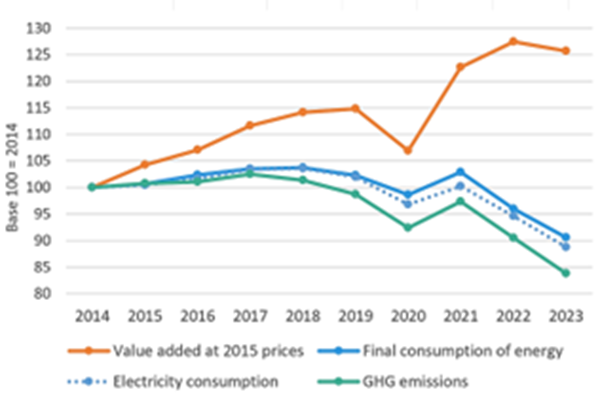
Figure 1 presents the evolution of EU manufacturing from 2014 to 2023: value added rose by roughly 25%, while final energy consumption, electricity use, and GHG emissions decreased by approximately 9%, 11%, and 16%, respectively. This represents strong relative decoupling: economic output growing while absolute energy use and emissions decline.
Figure 1: Trends in manufacturing sector: value added, energy/electricity consumption, and GHG emissions
Source: Eurostat data, TalTech calculations
Several factors shape this trend. The sharper decline in GHG emissions compared to energy consumption indicates progress in fuel switching towards lower-carbon fuels alongside energy reduction. Electricity consumption tracks total final energy closely, with no strong signal of widespread electrification in the aggregate. The notable drops in 2022–2023 coincide with unprecedented energy price spikes and likely include demand destruction, including temporary shutdowns and curtailed production in energy-intensive subsectors, rather than solely permanent efficiency improvements. Over the period, the share of energy-intensive industries1 in manufacturing value added decreased by 3 percentage points, which also influenced energy consumption through structural composition rather than technical efficiency improvements. These overlapping factors: decarbonisation, cyclical shocks, and sectoral shifts, collectively produce what appears as improved energy performance at the aggregate level, disaggregated analysis is needed [1] to distinguish genuine efficiency gains from structural and temporary effects.
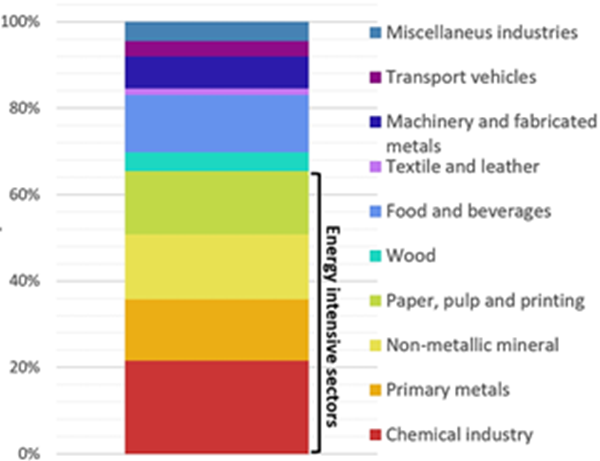
Figure 2 shows that EU manufacturing energy consumption is dominated by a small set of energy intensive branches (chemicals, primary metals, non-metallic minerals, and paper & pulp).
Figure 2: Share of manufacturing final energy consumption by subsector (EU-27, 2023)
Source: Odyssee database, TalTech calculations
Energy-intensive industries account for roughly 65% of total manufacturing energy consumption, while contributing only 20% of manufacturing value added and employing just 15% of the workforce (calculated separately from Eurostat and ODYSSEE 2023 data). This asymmetry is relevant for policy design: the sectors that dominate energy consumption can contribute disproportionately little to economic output and jobs, which matters when allocating policy effort and resources.
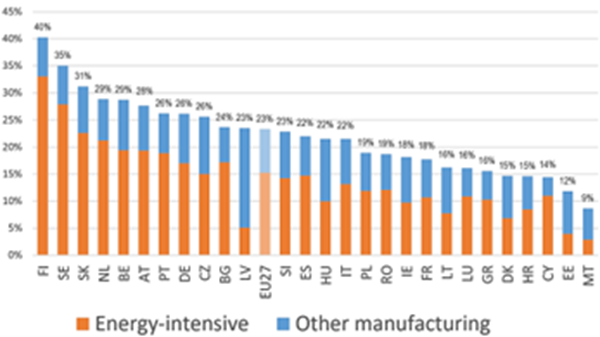
Figure 3 highlights large cross-country differences in manufacturing’s role in national energy demand. In several countries, such as Finland, Sweden, Slovakia, the Netherlands, manufacturing accounts for 30–40% of total final energy consumption, confirming the sector’s central role in national energy efficiency and decarbonisation strategies.
Figure 3: Manufacturing share in national final energy, split into energy-intensive and other manufacturing (EU-27, 2023)
Source: Odyssee database, TalTech calculations
Countries with low manufacturing energy shares (Malta, Estonia, Cyprus, below 15%) have either limited manufacturing activity or production concentrated in less energy-intensive branches, which constrains the national-level impact of industrial energy policies.
Energy Intensity by Subsector: What Drives the Differences
This section examines specific energy consumption, i.e. energy use per tonne of physical output, for selected energy-intensive industries using JRC-IDEES data (2023, [2]). The analysis focuses on the top 12 producing countries in each subsector, collectively covering 80–90% of total EU-27 production in the sectors presented. This illustrates how energy intensity differs once manufacturing is disaggregated into more homogeneous physical outputs, measured as specific energy consumption.
While specific energy consumption is more informative than aggregate manufacturing energy intensity, it still reflects multiple factors: process route, product quality, system boundaries, capacity utilisation, and plant vintage. Cross-country specific energy consumption comparisons cannot be interpreted as pure efficiency rankings without accounting for these structural differences. The following examples illustrate how specific energy consumption varies within steel, chemicals, pulp & paper, and non-metallic minerals, and what drives these variations.
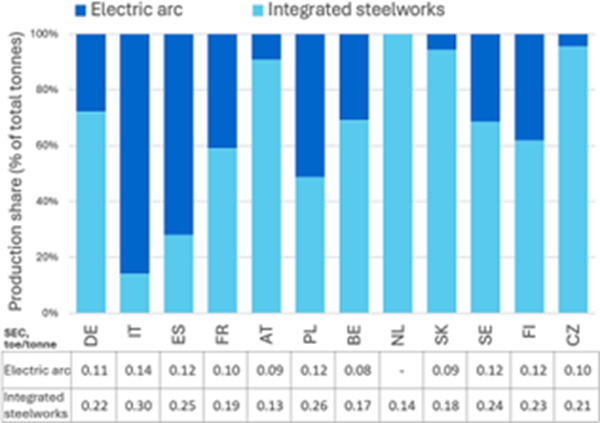
Figure 4 shows the production structure of crude steel across 12 EU countries, split by process route (integrated BF-BOF vs EAF2) with specific energy consumption values (in toe/tonne) displayed for each route within each country.
Figure 4: Crude steel production structure (BF–BOF vs EAF) and specific energy consumption - SEC (toe/t) by route in selected EU countries (2023)
Source: JCR IDEES database, TalTech calculations
The figure reveals substantial variation in both production structure and specific energy consumption. Some countries produce steel almost entirely through integrated BF-BOF routes (Netherlands 100%, Austria 93%, Slovakia 89%), while others rely predominantly on EAF (Spain 73%, Italy 69%). In Figure 4, EAF shows substantially lower specific energy consumption than BF-BOF, reflecting fundamental technological differences: EAF uses scrap and electricity to melt metal, while BF-BOF requires energy-intensive reduction of iron ore through coking and blast furnace operations.
Even within a single route, specific energy consumption varies substantially: for BF-BOF, Italy shows 0.30 toe/t while Austria shows 0.13 toe/t (Netherlands 0.14, Belgium 0.17). This variation cannot always be interpreted as a pure efficiency ranking. The EU Iron & Steel BREF [3] explicitly notes that specific energy consumption depends on, e.g.:
- the scope of the process - how much upstream preparation, secondary metallurgy, rolling / finishing is included in statistical boundary;
- product quality - high-grade specialty steels require more vacuum treatment, annealing, and precision rolling than commodity products;
- capacity utilisation and energy recovery.
Italy's high BF-BOF specific energy consumption may partly reflect operational disruptions at Taranto, running substantially below capacity in 2023 (30% capacity). Austria's lower intensity aligns with highly integrated sites featuring process-gas utilisation, cogeneration, and systematic energy management, that makes the route-specific indicator a closer proxy for technical energy efficiency here.
For EAF, specific energy consumption varies mainly with the charge mix and input quality (scrap vs DRI and/or hot metal share, scrap grade/cleanliness), plus product mix and the degree of secondary metallurgy/finishing required. For Italy (0.14 toe/t), there is evidence that some Italian EAF production can use pig iron and HBI on top of scrap specifically to achieve high-grade flat products [4]. Whereas some of the Austrian producers use high-purity scrap [5], which can also affect the specific energy consumption.
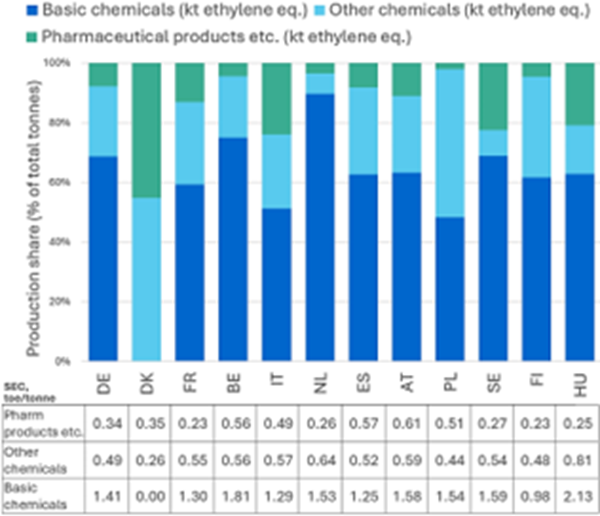
Figure 5 shows the chemical sector's production structure across 12 EU countries, expressed in ethylene-equivalent tonnes. This metric follows a JRC modelling approach3 that weights different chemical products by their relative energy and value-added intensities to enable cross-country comparison. The stacked bars display three subsectors: basic chemicals (including petrochemicals, ammonia, and other organic/inorganic basics), other chemicals (paints, detergents, solvents, asphalt-based products), and pharmaceuticals.
Figure 5: Chemical production structure (basic chemicals vs other chemicals vs pharmaceuticals) and specific energy consumption - SEC (toe/t) in selected EU countries (2023)
Source: JCR IDEES database, TalTech calculations
Production structure varies markedly across countries. Typically, the chemical sector’s output is dominated by “basic chemicals” (the Netherlands show the largest share at 90%, followed by Belgium, Germany and Sweden), while pharmaceuticals represent a relatively small share across all countries, with Denmark as a notable exception showing ~45% pharmaceutical production. Basic chemicals are the most energy-intensive segment (1.4 toe/t ethylene-equivalent on average), followed by “other chemicals” (0.5) and pharmaceuticals (0.4).
Energy intensity within the same subsector varies substantially due to internal product mix rather than pure efficiency differences. For basic chemicals, Hungary shows exceptionally high specific energy consumption (2.13 toe/t) while Finland shows the lowest (0.98 toe/t) - more than a twofold difference. Hungary's chemical industry has historically focused heavily on fertilisers and ammonia production, as well as naphtha steam-cracking. Both steam cracking and ammonia are among the most energy-intensive “anchor” processes inside basic chemicals. Whereas Finland does not have its own ammonia production (ammonia has been imported), which removes a major energy-intensive basic-chemical product from the national “basic chemicals” basket.
For other chemicals (paints, detergents, solvents), specific energy consumption ranges from 0.26 toe/t (Denmark) to 0.81 toe/t (Hungary), with most countries clustered between 0.44–0.59 toe/t. Denmark’s low value is consistent with a sector mix tilted toward supplying a very large pharma industry rather than bulk commodity chains [6]. Hungary’s high value likely reflects a larger weight of electricity/steam-intensive heavy chemical operations (e.g., chlor-alkali and the VCM/PVC chain, for example, BorsodChem).
Pharmaceuticals show specific energy consumption ranging from 0.23 toe/t (Finland, France) to 0.64 toe/t (Netherlands). Pharmaceuticals are typically high value-added, lower bulk-tonnage products where energy demand is dominated by HVAC/cleanroom requirements, solvent handling, and batch separations rather than high-temperature chemical reactions. The literature documents that cleanrooms can be orders of magnitude more energy-intensive than normal spaces and that HVAC can account for >50% of electricity use in pharma cleanroom systems [7], which suggests that the observed variation can reflect differences in cleanroom standards and product mix rather than process efficiency.
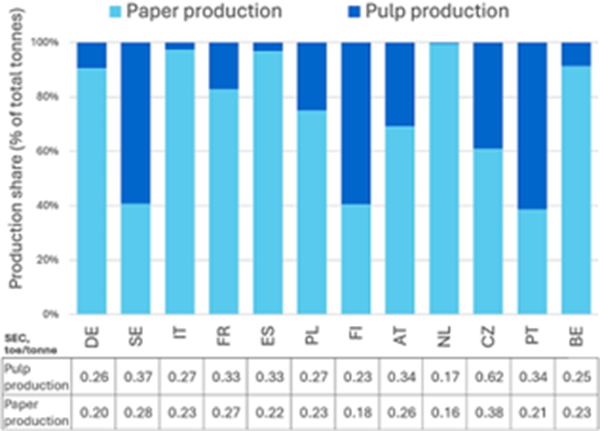
Figure 6 compares the pulp & paper production4 structure across selected EU countries and shows route-specific energy use per tonne (toe/t) inside each bar. Across EU countries, the pulp & paper sector shows strong structural heterogeneity: most countries are paper-dominated, while Sweden, Finland, Portugal and Czech Republic have a much larger pulp share.
Figure 6: Pulp and paper production structure (pulp vs paper) in selected EU countries (2023)
Source: JCR IDEES database, TalTech calculations
Production of pulp is on average more energy-intensive than paper production. The EU Pulp and Paper BREF [9] explicitly notes that specific energy consumption depends on, e.g.:
- fibre route (virgin vs recovered; chemical vs mechanical pulping; kraft vs sulphite processes);
- product grade mix (e.g., tissue vs packaging);
- integration and on-site energy recovery (black liquor/biomass and CHP).
For pulp production, Czech Republic's exceptionally high specific energy consumption in 2023 (0.62 toe/t) contrasts with Finland (0.23 toe/t)—nearly a 3× spread. Finland, one of Europe’s major chemical pulp producers, shows only moderate specific energy consumption, which is consistent with integrated kraft mills that recover substantial amounts of energy from black liquor and can approach thermal energy self-sufficiency. Czech Republic’s outlier may reflect data/classification effects, so cautious interpretation is needed [8].
For paper production, Czech Republic again shows the highest energy intensity (0.38 toe/t) while the Netherlands and Finland show the lowest (0.16 and 0.18 toe/t respectively). For the Netherlands, this can be partly explained by sectoral structure: Dutch paper and board production relies overwhelmingly on recovered fibre, so the national average reflects recycled-fibre (repulping + papermaking) systems rather than virgin wood-to-pulp production, typically requiring substantially less energy per tonne.
Conclusions
Official statistics show that EU manufacturing has achieved relative decoupling: value added increased while final energy use and GHG emissions declined. However, aggregate energy-intensity indicators (energy per € output) inevitably mix technical efficiency with shifts in product mix, process routes, utilisation, and sector boundaries, and can move sharply during price shocks without corresponding efficiency gains.
Even within subsectors measured by physical output, e.g. steel by route, basic chemicals, pulp and paper, energy intensity varies by factors of 2 to 3 across countries, driven not only by efficiency but also by technological choices, product specialisation, site integration, and capacity utilisation.
Indicators such as ODEX, which incorporate physical activity data, improve on simple energy intensity measures but remain constrained by data availability and aggregation.
Reliable assessment of energy efficiency progress requires complementing top-down statistics with micro-level evidence, notably energy audit data. Audit datasets provide process-specific measures, savings potentials, and plant benchmarks, enabling better interpretation of statistical trends and targeted policy design.
Notes
- 1: Energy-intensive industries are defined here using a simplified ODYSSEE-style grouping (chemicals, primary metals, non-metallic minerals, and paper/pulp) and may not fully match all official taxonomies.
- 2: BF-BOF = blast furnace–basic oxygen furnace route; EAF = electric arc furnace route.
- 3: Based on JRC-IDEES sector definitions and method. Ethylene-equivalent” output for chemicals is a modelled representative output, derived from sector energy balances and subsector value-added statistics using assumed relative energy/value-added intensities of key product groups; it is designed to make cross-country comparisons more meaningful for energy analysis, not to replicate physical tonnage by product exactly.
- 4: Based on JRC-IDEES sector definitions. “Pulp production”: NACE Rev.2 C17.11. “Paper production”: C17.12 and C17.2.
References
- [1] Lapillonne, B. et al. (2026). Energy efficiency trends in industry. Odyssee-Mure Policy Brief, January 2026.
- [2] Rozsai, M. et al. (2025). JRC-IDEES-2023. European Commission, Joint Research Centre (JRC) [Dataset].
- [3] European Commission, Joint Research Centre. (2013). Best Available Techniques (BAT) Reference Document for Iron and Steel Production. Publications Office of the EU.
- [4] Sandbag. (2022). Starting from scrap. [https://sandbag.be/wp-content/uploads/Sandbag-Starting-from-Scrap.pdf].
- [5] Voestlapine. (2026). The new special steel plant. [https://www.bohler-bleche.com/en-us/sustainability/]
- [6] Cefic. (n.d.). Chemical industry snapshot: Denmark.
- [7] Loomans, M. G. L. C. et al. (2019). Energy demand reduction in pharmaceutical cleanrooms through optimization of ventilation. Energy and Buildings, 202, 109346.
- [8] Motiva. (2019). Energy Efficiency of Finnish Pulp and Paper Sector.
- [9] European Commission, Joint Research Centre. (2015). Best Available Techniques (BAT) Reference Document for the Production of Pulp, Paper and Board. Publications Office of the EU.
April 2026